Menu
Download our Petland App today for information on your local Petland's Available Pets and Pet Supplies. All at the tips of your fingers!


Download our Petland App today for information on your local Petland's Available Pets and Pet Supplies. All at the tips of your fingers!
Please create a free account, or login by clicking here.
Petland Memphis, Tennessee
August 31, 2026
Watching a Beagle puppy grow from a tiny, playful puppy into an active young dog is an exciting experience. During the first year, your Beagle will go through many physical, behavioral, and developmental changes. Understanding what to expect at each stage can help you provide the right nutrition, exercise, training, and care.
While every Beagle grows at a slightly different rate, genetics, nutrition, activity level, overall health, and body condition all influence development. A growth chart should therefore be used as a general guide rather than a strict target. Regular weight checks and veterinary examinations are the best way to make sure your puppy is developing appropriately.
Beagles are a small-to-medium-sized breed, and they generally mature considerably faster than large breeds. Most of their physical growth occurs during the first six months, although they may continue developing muscle and body condition after reaching most of their adult height.
Here is a general overview of what you may see during the first year:
| Age | What to Expect |
|---|---|
| 8–10 weeks | Rapid growth, lots of sleep, socialization, beginning house training |
| 10–12 weeks | Increasing curiosity, improved coordination, teething begins |
| 3–4 months | More active, learning quickly, developing confidence |
| 4–6 months | Rapid physical development, permanent teeth begin appearing, increased energy |
| 6–9 months | Adolescent stage, more independence, continued muscle development |
| 9–12 months | Approaching adult size, continued behavioral and physical maturity |
| Around 1 year | Young adult, usually close to full physical size |
Remember that individual puppies can be ahead of or behind these general milestones and still be perfectly healthy.
Find Beagle Puppies for sale here.
At around eight weeks, many Beagle puppies are ready to transition to their new homes. This is an important developmental period because your puppy is learning about people, sounds, environments, routines, and other animals.
Your eight-week-old Beagle may still seem very small, but there is already a lot happening developmentally. Puppies at this age are becoming increasingly curious and are beginning to explore their surroundings more confidently.
This is also an important time for positive socialization. Your puppy can gradually experience different people, safe environments, household sounds, surfaces, and appropriate interactions with other dogs. The goal is to create positive experiences without overwhelming the puppy.
At this age, focus on:
Don’t be surprised if your puppy sleeps for much of the day. Growing puppies need substantial rest to support healthy development.
Between 10 and 12 weeks, your Beagle puppy will usually become more curious and adventurous. You may notice your puppy exploring more of the house, investigating new smells, and becoming increasingly interested in everything around them.
Beagles are scent hounds, so their nose can become one of their most noticeable characteristics as they grow. A fascinating smell can be enough to distract a young Beagle from whatever you were trying to teach them.
Continue using short, positive training sessions. This is also a good time to work on simple behaviors such as:
Your puppy is also likely to become more interested in chewing as teething progresses. Providing safe, appropriate chew toys can help redirect this natural behavior.
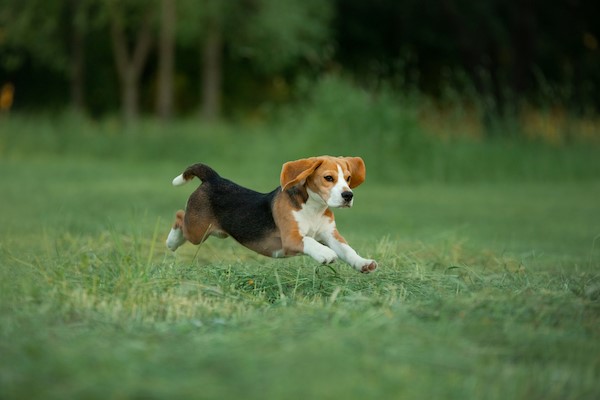
At three to four months, your Beagle is becoming more coordinated and active. You may notice that your puppy can run, play, climb, and explore with considerably more confidence than just a few weeks earlier.
This is an important period for continuing socialization and training. Your puppy is learning what behaviors are acceptable and what is expected within the household.
Beagles can be intelligent and eager to explore, but their strong scent drive can sometimes make training challenging. Consistency and positive reinforcement are particularly important.
At this stage, continue to:
Avoid expecting your puppy to have the focus or self-control of an adult dog. Training should remain short, positive, and appropriate for their age.
The four-to-six-month period can be one of the busiest stages of puppyhood.
Your Beagle may become much more energetic and may begin testing boundaries. Permanent teeth also start replacing puppy teeth during this general period, which can increase the desire to chew.
You may notice behaviors such as:
This is an excellent time to reinforce the training you have already started rather than assuming your puppy has “outgrown” unwanted behaviors.
Beagles are energetic dogs, and appropriate activity can help prevent boredom. However, growing puppies should not be pushed into excessive or prolonged exercise. Their bones and joints are still developing, and AKC recommends avoiding excessive activity that could put unnecessary stress on growing structures.
At around six months, your Beagle may start looking much more like a young dog than a tiny puppy.
You may see continued growth in height and body length, along with increasing muscle development. However, physical size isn’t the only change happening at this stage.
Your puppy is also becoming more independent.
Some Beagles may suddenly seem as though they have forgotten commands they previously understood. This is often part of adolescence rather than a sign that training has failed.
Keep practicing:
Beagles are naturally curious, so giving them appropriate opportunities to explore and use their nose can be an important part of keeping them mentally engaged.
Between seven and nine months, your Beagle may be approaching much of their adult physical size, although they can continue to develop afterward.
This is often a stage where owners notice a combination of confidence, independence, and plenty of energy.
Your Beagle may become more interested in exploring their surroundings and following interesting scents. This makes reliable recall especially important.
Continue using secure leash and outdoor practices. A fenced area can provide a safer opportunity for exercise and exploration than allowing a young Beagle to roam freely.
Training should remain part of your daily routine. Short sessions can reinforce good habits while giving your dog an opportunity to use their developing brain.
Between nine months and one year, many Beagles are getting close to their adult physical size.
However, “almost full grown” doesn’t necessarily mean “fully mature.” A puppy can reach most of its adult height while continuing to develop muscle, body condition, coordination, and emotional maturity.
AKC notes that dogs can continue physical and behavioral development beyond their first birthday, with the exact timeline varying according to breed and individual dog.
During this period, continue focusing on:
By one year, a Beagle is generally much closer to adult size than they were as a puppy. However, individual dogs mature at different rates.
Some dogs may continue filling out after reaching their adult height. Muscle development and body composition can continue changing as a young dog transitions into adulthood.
Rather than focusing only on the number on the scale, pay attention to your Beagle’s overall body condition and development.
Your veterinarian can help determine whether your puppy is maintaining a healthy weight and growing appropriately.
There is no single “perfect” weight for every Beagle puppy at a particular age.
Two puppies of the same age can have different weights because of differences in genetics, sex, body structure, litter history, diet, and activity level.
For that reason, a growth chart should not be treated as a pass-or-fail test.
A better approach is to monitor your puppy consistently. AKC recommends regularly weighing puppies and recording their progress so owners and veterinarians can identify unusual changes in growth.
If your puppy suddenly stops gaining weight, loses weight unexpectedly, appears unusually thin or overweight, or shows other signs of illness, contact your veterinarian.
One of the easiest ways to monitor your Beagle puppy is to keep a simple growth record.
Record:
For young puppies, weekly weight checks can provide useful information about the direction of growth. However, don’t become overly concerned about small fluctuations. Individual puppies do not all follow exactly the same growth curve.
Your veterinarian can also evaluate your puppy’s body condition rather than relying on weight alone.
Nutrition plays an important role in healthy puppy development.
During the first year, puppies need a complete and balanced diet formulated for growth. Feeding recommendations should be based on your puppy’s age, weight, activity level, and the specific food being used.
As puppies mature, their feeding schedule generally changes. AKC notes that young puppies may initially require several meals per day, while older puppies generally transition toward fewer meals.
Avoid trying to make your Beagle grow faster by simply increasing food. Rapid or excessive growth is not the goal. The objective is steady, healthy development.
Follow the feeding instructions on your puppy’s food and discuss adjustments with your veterinarian if your puppy is gaining weight too quickly or too slowly.
Beagles are active dogs that benefit from regular physical activity and mental stimulation. However, growing puppies should not be treated like adult dogs when it comes to exercise.
Short walks, supervised play, age-appropriate games, and opportunities to explore safely are generally better choices than forcing a young puppy to participate in prolonged or strenuous activity.
AKC specifically cautions against excessive, prolonged exercise while puppies are still developing.
Mental exercise is just as important. Puzzle toys, scent games, basic training, and controlled exploration can help keep an active Beagle puppy occupied.
Physical development isn’t the only growth taking place during your Beagle’s first year.
Your puppy is also developing social skills, confidence, habits, and emotional maturity.
For Beagles, early socialization is particularly important. AKC recommends exposing young Beagles to different people, dogs, environments, sounds, and situations in a positive and appropriate way.
The habits you establish during puppyhood can influence how your Beagle behaves as an adult.
Consistent training, clear boundaries, positive reinforcement, and appropriate socialization can help your puppy become a confident and well-adjusted companion.
Every puppy develops differently, but certain changes deserve attention.
Talk to your veterinarian if you notice:
Your veterinarian can assess your Beagle’s growth using their weight, body condition, physical development, medical history, and breed characteristics.
Beagle puppies grow rapidly during their first several months, with much of their physical development occurring during the first six months. Growth generally slows as they approach adult size.
Many Beagles are close to their adult size by around one year, although individual dogs can continue developing beyond their first birthday. Physical maturity and emotional maturity do not always happen at exactly the same time.
The appropriate weight depends on your puppy’s age, genetics, sex, body structure, and overall body condition. Rather than relying on one number, track your puppy’s growth over time and ask your veterinarian to assess their body condition.
Weekly weight checks can be useful during puppyhood. Recording the results gives you a growth history that can also be shared with your veterinarian.
Some Beagles may continue filling out and developing muscle after their first birthday. Reaching adult height does not necessarily mean every aspect of physical and emotional maturity is complete.
Feed a complete and balanced puppy diet appropriate for growth and follow the manufacturer’s feeding recommendations. Your veterinarian can help determine the right amount based on your puppy’s body condition and growth rate.
Your Beagle’s first year is filled with rapid physical growth, new experiences, training challenges, and important developmental milestones. From the tiny eight-week-old puppy coming home for the first time to the energetic young dog approaching their first birthday, every stage brings something new.
The most important thing is not whether your Beagle matches an exact weight at a specific age. Instead, focus on steady growth, healthy body condition, appropriate nutrition, safe exercise, regular veterinary care, socialization, and consistent training.
With the right care and plenty of patience, those first 12 months can help set the foundation for a happy, healthy Beagle companion for years to come.