Menu
Download our Petland App today for information on your local Petland's Available Pets and Pet Supplies. All at the tips of your fingers!


Download our Petland App today for information on your local Petland's Available Pets and Pet Supplies. All at the tips of your fingers!
Please create a free account, or login by clicking here.
Petland Memphis, Tennessee
November 17, 2026
People will tell you a tired puppy sleeps through the night, the way a tired baby is supposed to. What that leaves out is the detail that decides your first week: a puppy is not built to sleep through anything. An 8-week-old has a bladder that holds about 3 hours, has slept its whole life against littermates, and has never been alone in the dark. Puppy crying at night in week one is not bad behavior. It is a small animal doing exactly what its age predicts.
Here is what normal looks like. Nights 1 and 2 are the loudest, with crying in bursts of 10 to 30 minutes, especially after lights-out and after each toilet trip. Most puppies improve visibly by night 3 or 4, and by the end of week one the majority settle within 5 to 10 minutes and wake mainly when their bladder says so. The owners who get there fastest run the same boring routine every night, so the puppy can learn it.
This guide gives you that routine: the bladder math that sets your alarms, where the crate goes, a plan for nights 1 to 7, and the daytime habits that buy sleep. Follow it for one week before judging it.
Expect three kinds of noise, and learn to tell them apart. Lonely crying starts as the house goes quiet, rises and falls, and often pauses if the puppy hears a calm voice. Toilet crying comes 2 to 4 hours after the last trip out, is more insistent, and comes with circling and sniffing in the crate. Wide-awake crying after a toilet trip is the puppy hoping the night has become playtime. Each gets a different response, and mixing them up is how owners train a 3 a.m. party.
Also expect worse crying if pickup day ran long. A puppy that traveled, met six new people, and explored a new house until 9 p.m. is overtired, and overtired puppies cry more, not less. Keep day one dull: home, yard, crate, play sessions of 15 to 20 minutes, and naps. A puppy that has only ever rested near you has no practice at resting alone, and night is just the longest alone stretch. That is why the benefits of crate training a dog start in the daytime, with short, positive crate sessions before bedtime depends on them.
Use the standard rule: a puppy can hold its bladder at night for roughly its age in months plus one, in hours. Two months plus one is 3 hours; three months plus one is 4. Treat the formula as your ceiling, not a promise. Set alarms from it and you wake the puppy for a quiet trip before its bladder wakes both of you. That order matters: a puppy taken out sleepy and bored goes back to sleep. A puppy that has cried itself fully awake often does not.
| Age | Expected night stretch | Toilet trips per night |
| 8 weeks (2 months) | About 3 hours | 2 to 3 |
| 10 to 11 weeks | 3 to 4 hours | 2 |
| 12 weeks (3 months) | About 4 hours | 1 to 2 |
| 16 weeks (4 months) | About 5 hours | 1 |
| 20 weeks (5 months) | About 6 hours | 0 to 1 |
| 6 months | 6 to 7 hours | 0 for most puppies |
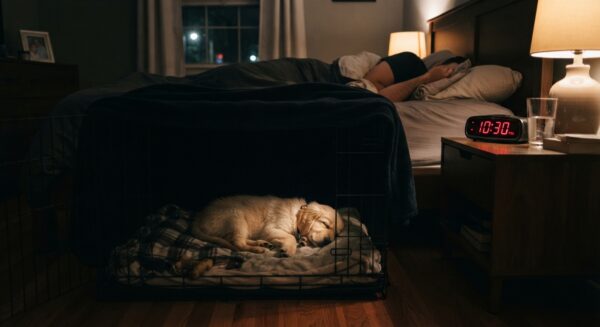
For week one, put the crate in your bedroom, within a few feet of the bed, close enough that the puppy can hear you breathe. This is not spoiling. Separation is a skill built in steps, and night one in a strange house is the wrong test. Owners who start the crate in the kitchen usually get more crying, then cave at 2 a.m., teaching the puppy that volume works. Start close, and from night 4 or 5 move the crate a few feet further every 2 nights until it reaches its permanent spot.
Cover the top and sides of a wire crate with a light blanket, leaving the front open and airflow clear. Most puppies settle faster in a darker, enclosed-feeling space. Add one worn T-shirt that smells like you, one safe chew, and keep the space small with the divider: a puppy will not soil where it sleeps, and that instinct is your toilet training engine. Starting from zero, follow crate training made simple in the day first: meals fed inside, short closed-door sessions with treats, so the crate means rest before bedtime.
Run the routine in section 5, lights out, and expect 10 to 30 minutes of crying at bedtime and shorter bursts after each toilet trip. Do not open the crate at full volume. Wait for a pause, even 5 seconds of quiet, and use that pause if you need to intervene. A low, boring voice and a hand on the crate for a minute is the maximum comfort on offer. With a 10:30 p.m. last out and 3-hour limits, expect trips at roughly 1:30 and 4:30 a.m. Run calmly, these nights are usually the worst you get.
Bedtime crying usually drops to 5 to 15 minutes, and many puppies are asleep when an alarm rings. If yours is, let it sleep and push that trip 30 minutes later the next night. Keep everything else identical. This is where owners relax the routine, allow a late exciting play session, or move the crate, then wonder why night 5 regresses. When you read about puppy crying at night, this midweek discipline is what separates puppies who settle by day 7 from those still rehearsing at day 14.
By now most puppies settle in under 10 minutes and need one planned trip, or none beyond a 5:30 to 6 a.m. wake-up that gradually becomes your normal morning. Start moving the crate away from the bed in small steps if its permanent home is elsewhere, and drop the middle alarm once your puppy has slept through it twice. Keep last-out time fixed: same times, same words, same dark boring trips, all 7 nights, and the routine itself becomes the signal that teaches sleep.
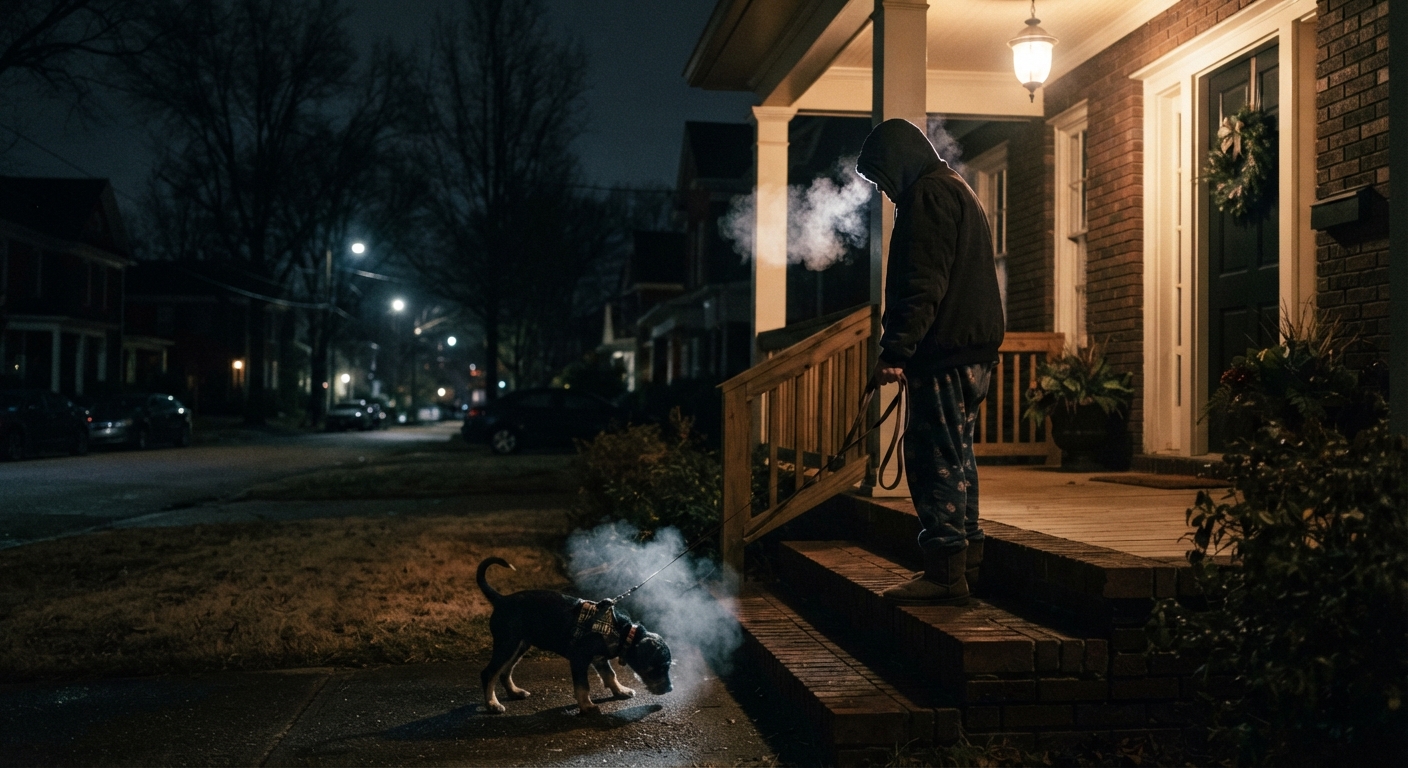
Build the last hour on purpose. Final meal by 6:30 to 7 p.m. for an 8 to 12-week-old, water picked up about an hour before bed, and a calm play and training session ending by 9:30 p.m. Last out at 10 to 10:30 p.m., on leash, in the same patch of yard, with a cue word and quiet praise. December in Memphis makes that trip cold and dark, so coat on, porch light on, 5 minutes maximum. Then crate, cover, lights out.
Every night trip follows the 3-minute rule: leash on, same spot, cue word, toilet, quiet praise, straight back to the crate. No play, no food, no lights beyond a dim hallway lamp. Boring on purpose. If nothing happens in 5 minutes, go back in and reset the alarm for 30 minutes. Puppies learn within days that night trips buy nothing interesting, and that lesson alone ends most post-trip crying by night 4 or 5.
Do not scold crying. A puppy is not manipulating you in week one; it is reporting discomfort the only way it can, and scolding adds fear to loneliness. Do not thump the crate, spray water, or shout from another room. Do not ignore genuine toilet crying either: if it has been 3 hours and the crying is escalating, take the puppy out on the 3-minute rule and reset. Ignoring a full bladder teaches crate soiling, which is far harder to fix than crying.
Be honest about the bed question. Bringing the puppy into your bed as a panic fix at 2 a.m. works instantly, which is exactly why it sticks. If you want an adult dog on the bed, that is a legitimate choice; make it on a calm evening, not as a surrender, and accept the toilet and chewing risks. If you do not, do not start in week one and try to undo it in week three. That reversal is the hardest version of this problem owners create.
Night sleep is built between 7 a.m. and 10 p.m. Feed on a schedule, 3 measured meals under 12 weeks, so the night’s last toilet is predictable. Protect naps: puppies need 18 to 20 hours of sleep in 24, and a puppy kept awake all evening by visitors crashes into an overtired, wired state at bedtime and cries harder. Practice 3 to 4 short crate naps a day, cover on, so alone-rest is rehearsed in daylight. Add one gentle early-evening training session, 10 minutes is plenty at 9 weeks, ending before the puppy is frantic.
Finally, wear the puppy out mentally, not physically. Ten minutes of sniffing games, a frozen stuffed toy, or learning sit and name recognition tires a young puppy more safely than a long walk, and joints at 8 to 12 weeks should not be doing forced exercise. Do this daily: scheduled meals, protected naps, crate practice in daylight, a calm last hour. Boring days build quiet nights.
Puppy crying at night is a one to two week project for most families, not a personality trait. The formula is unglamorous: crate close, alarms set by age in months plus one, a 10:30 p.m. last out, 3-minute boring trips, the same routine for 7 straight nights. Run it without improvising and the crying shrinks on schedule: loud nights 1 and 2, a turn at 3 and 4, a puppy settling in minutes by week’s end.
If your puppy has not come home yet, the team at Petland Memphis can help you set up the crate, divider, and first-week schedule before pickup day, so night one is already planned. Browse Petland Memphis available pets to see who is looking for a home, and ask us to walk through this plan for the puppy you choose.
How long will my puppy cry at night?
Most are loud for 2 to 3 nights, improve by night 3 or 4, and settle within 5 to 10 minutes by the end of week one on a consistent routine.
Should I let my puppy sleep in my bedroom?
Yes, crated in your bedroom for at least week one. Proximity cuts crying, and you can move the crate further every 2 nights once settling is reliable.
How long can a puppy hold its bladder at night?
Age in months plus one, in hours: about 3 hours at 8 weeks, 4 at 3 months, and 5 at 4 months, slightly longer at night than in the day.
Should I take my puppy out when it cries at night?
If it is near the bladder limit, yes: leash on, same spot, 3 minutes, no play, straight back to the crate. Ignoring toilet crying teaches crate soiling.
Can I scold my puppy for crying in the crate?
No. Scolding week-one loneliness crying adds fear and slows settling. Answer toilet needs on the boring 3-minute rule and let comfort crying burn out.
Is it okay to let my puppy sleep in my bed instead?
Only as a calm, permanent choice, not a 2 a.m. surrender. Undoing bed access in week three is much harder than one week of crate routine.